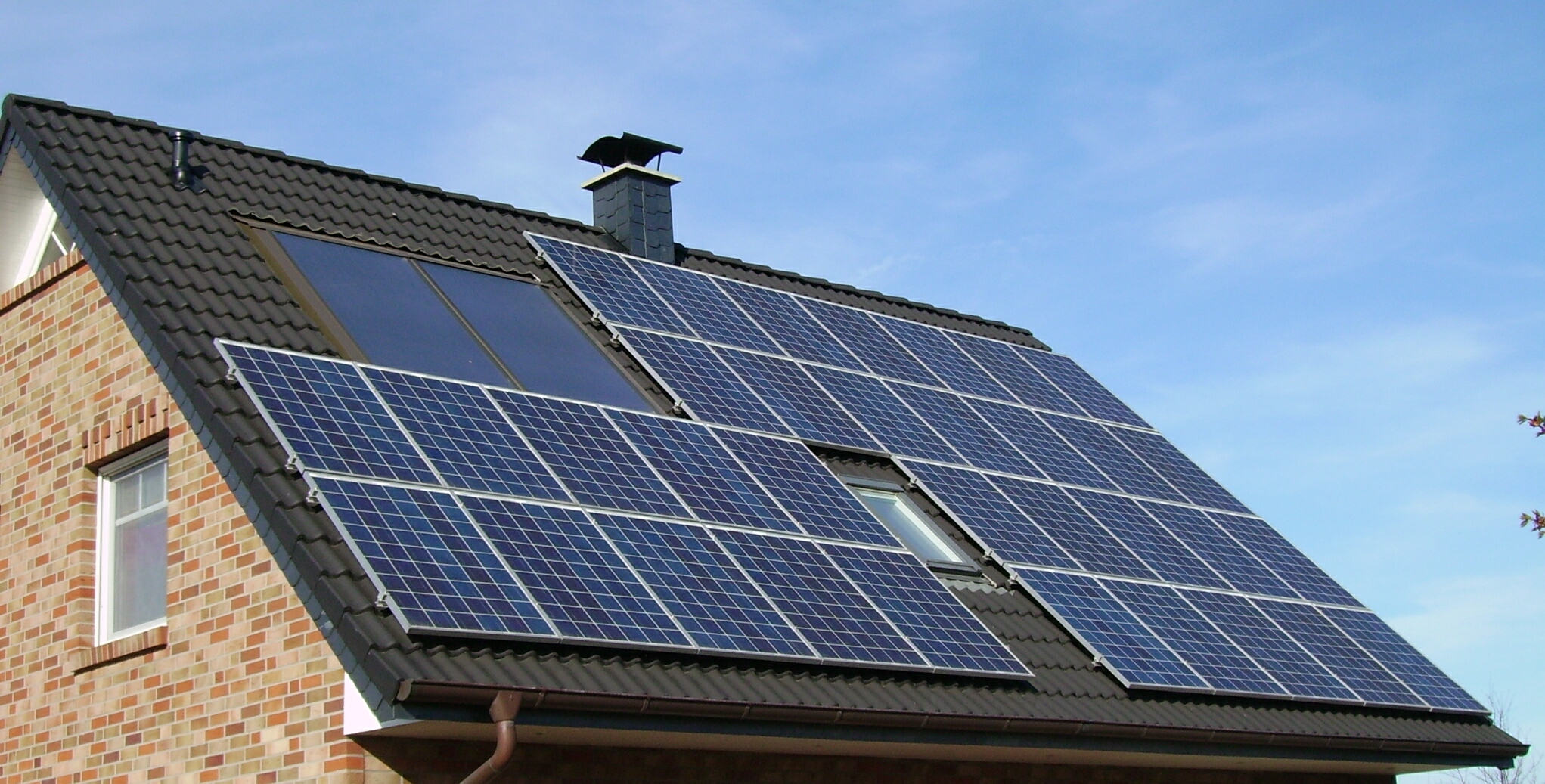
Solar panels have become a common sight on Polish rooftops over the past decade. Between 2019 and 2024, Poland's installed photovoltaic capacity grew from under 1 GW to more than 17 GW, making it one of the fastest-expanding markets in Central Europe. Despite this growth, many property owners still have fundamental questions about how the technology works and what a realistic installation looks like in the Polish context.
The basic conversion process
A photovoltaic panel contains solar cells made primarily of silicon, a semiconductor material. When photons from sunlight strike the cell, they dislodge electrons from their atoms, creating a flow of electric current. This current is direct current (DC). An inverter connected to the panels converts it to alternating current (AC), which is the standard used by household appliances and the national grid.
The efficiency of this conversion — how much of the incoming solar energy becomes usable electricity — currently ranges from about 15% for standard polycrystalline panels to 22–24% for premium monocrystalline PERC or TOPCon cells. Higher efficiency panels generate more power per square metre, which matters when roof space is limited.
What affects output in Poland
Poland sits between roughly 49° and 54° north latitude. This means solar irradiation is lower than in southern Europe but comparable to Germany and the Netherlands, both countries with large and well-documented PV industries. The national average for horizontal global irradiation is around 1,050–1,150 kWh/m² per year, with the south and southwest of the country receiving somewhat more than the north and northeast.
A south-facing roof pitched at 30–35° gives the best annual yield. For an installation of this type in central Poland, a 1 kWp (kilowatt-peak) system produces approximately 950–1,050 kWh per year. A typical 6 kWp residential installation would therefore generate between 5,700 and 6,300 kWh annually — enough to cover a substantial share of household consumption, which averages around 3,500–4,500 kWh per year for a family of four.
Note on self-consumption: The financial return from a PV system depends heavily on the share of electricity consumed directly rather than exported to the grid. Under Poland's current net-billing system (in effect since April 2022), exported electricity earns market-rate credit rather than the one-to-one exchange of the previous net-metering scheme. Systems designed with battery storage or time-shifted consumption habits typically see better financial outcomes.
Main system components
A grid-connected residential PV installation in Poland typically includes:
- PV modules — the panels themselves, usually 370–420 Wp each for modern monocrystalline products. A 6 kWp system requires roughly 14–16 panels.
- Inverter — converts DC from the panels to AC. String inverters are the most common and cost-effective choice. Microinverters (one per panel) offer better performance when panels are partially shaded but cost more.
- Mounting structure — aluminium rails fixed to roof rafters. For flat roofs, ballast-weighted frames allow tilt adjustment without roof penetration.
- Generation meter and bidirectional meter — to measure output and grid exchange. The energy supplier installs the bidirectional meter, usually within 30 days of a prosumer application.
- AC and DC cabling, isolators, and surge protection — required by Polish building and electrical regulations.
The installation process
Most residential installations are completed in one working day for systems up to 10 kWp. The sequence is broadly:
- Roof assessment and structural check — important for older buildings where rafter spacing or tile condition may limit panel placement.
- Mounting rail installation.
- Panel placement and DC cabling.
- Inverter installation, usually in a garage, utility room, or on an external wall sheltered from direct weather.
- Connection to the distribution board.
- Submission of a prosumer notification to the distribution system operator (DSO) — required before grid connection, typically takes 21–30 days to process.
Installations above 50 kWp require a building permit. Below this threshold, a notification to the local authority (zgłoszenie) is sufficient in most cases, though regulations can vary by municipality.
What output looks like across the year
Poland's solar resource is highly seasonal. July production from a 6 kWp south-facing system might reach 700–800 kWh; December production from the same system might fall to 60–100 kWh. This means winter heating needs cannot be covered by solar electricity alone without substantial storage or a hybrid system combining PV with a heat pump and thermal buffer tank.
The practical implication for system sizing: a 6–10 kWp installation covers electricity needs well from April through September and partially from October through March. Households with electric vehicles or heat pumps often size systems at 10–15 kWp to make more use of summer surplus.
Warranties and expected lifespan
Quality PV panels from established manufacturers carry a product warranty of 10–15 years and a power output warranty guaranteeing at least 80–85% of rated output after 25 years. In practice, well-maintained panels often last 30 years or more. Inverters typically require replacement after 10–15 years; this cost should be factored into financial projections.
For further context on the Polish photovoltaic market, the Institute for Renewable Energy (IEO) publishes annual market reports, and the Ministry of Climate and Environment maintains current regulations and subsidy programme details.

